Scientific or technical reports
Reports are different than scientific papers in that they do not represent original research. Rather their purpose is to summarize the latest scientific research for non-scientists. Care is taken to make sure the language is less technical and more accessible to non-scientists. They usually have different chapters that may address different audiences and interests. For example, they may have different chapters addressing the effects of climate change on different sectors of the economy or different regions of the world, or different ecosystems.
Often, you may only be interested in a small section or chapter of the report. Therefore, you should always check the table of contents for the topic of interest. Different chapters usually have different authors, so you may need to cite the specific chapter in the references and the specific author in the text.
In government or academic reports, you may copy and paste tables or figures provided that you cite and reference them to give credit. If you do not do this it is considered plagiarism as the assumption is that the figures are your own. Some private organizations may demand that you ask permission: this is usually a formality, especially in the case of a student paper, but some organizations can be very proprietary about this.
Thursday, June 25, 2015

Friday, December 14, 2012
Inserting equations
Here are some tips on formatting equations:
- Number equations for future referencing
- Use an equation editor where necessary to produce clear equations
- If there is more than one equation, equations should be listed and described separately.
- They should be indented or centered from the rest of the text
- There should be a space separating them from text both above and below the equation
- All variables should be defined directly after or directly before the equation
Example:
The annual probability p of a single season without a hurricane landfall was calculated for a 160 year period by calculating the number of years n without a landfall event over the total number of years N in the dataset:
p = n/N (1)
The annual probability was used in tandem with the binomial distribution to determine the likelihood P(X) of X years free of a hurricane landfall occurring over a finite period of N years:
 (2)
(2)
Calculations were performed for values of N=11 and X=5.
Based off
The expression "based off" or worse "based off of" (used when a writer really means "based on") should be banned from your scientific lexicon. It is not only non-existent in the English language, it makes no sense.
Take this example: "Good scientific writing is based on sound knowledge of the English language". The science student is secure in the knowledge that scientific writing is fixed on the rock-solid foundation of his/her knowledge of the English language.
However, as the image below shows, when "Scientific writing is based off of knowledge of the English language", there is nothing there to hold up good scientific writing. It's up in the air. The science student and Whiskers the kitten live in a very precarious state. What follows is not pretty for the science student or for Whiskers..

So keep in mind that the expression "based off" is no substitute for "based on", and actually means the opposite.
More importantly, remember that every time you use the expression "based off", a kitten dies. If only for the sake of kittens, please "use based on" instead of "based off".
Take this example: "Good scientific writing is based on sound knowledge of the English language". The science student is secure in the knowledge that scientific writing is fixed on the rock-solid foundation of his/her knowledge of the English language.
However, as the image below shows, when "Scientific writing is based off of knowledge of the English language", there is nothing there to hold up good scientific writing. It's up in the air. The science student and Whiskers the kitten live in a very precarious state. What follows is not pretty for the science student or for Whiskers..

So keep in mind that the expression "based off" is no substitute for "based on", and actually means the opposite.
More importantly, remember that every time you use the expression "based off", a kitten dies. If only for the sake of kittens, please "use based on" instead of "based off".
Tuesday, May 3, 2011
Sunday, April 3, 2011
How to read a scientific paper in meteorology -
How to read a scientific paper
- Scientific papers are designed so that other scientists can check and reproduce the results; they go into too much detail to read entirely unless you are going to reproduce the results in your own research.
- Start by reading Abstract; this summarizes the main findings of the paper.
- Read the Introduction; this introduces the subject, explains its significance, and cites earlier work that is often relevant to the topic.
- The Summary/Conclusion/Discussion usually contains the main results of the paper and discusses their implication for future research.
- Examine some Figures, Tables in the main body of the text, and read a section of the paper that describes what it is they depict; choose a section that looks interesting and that you think is easy to understand.
Finding more information
- Check the references of the journal; this leads to articles cited by the article you are reading
- Check the more recent articles that cited this paper at the bottom of the article; the more citations you find here, the more likely that the paper
Saturday, April 2, 2011
How to research a topic
How to find information on a topic
Do a Google search for:
Do a Google search for:
- Websites, blogs, even wikipedia are a good place to start but usually cannot be cited in your paper;
- Research (UCAR,NOAA,NWS) and university websites are more reliable than Wikipedia and popular sites and can in most circumstances be included as references.
- Refereed papers from scientific journals are the most reliable source as they have been scrutinized by at least three reviewers (called referees); research websites often provide references from the refereed literature.
- Archive of LSC Senior thesis: These provide relevant sources for your paper and can give you a concrete idea of what a good thesis or paper looks like; remember to reference it in your list of references if you use it.
- Weather forecasting
- COMET modules are educational modules on various topics developed by weather forecasters
- National Weather Service websites (NOAA, BTV, ALB, BOS) offer regional and forecast-related research that is not necessarily published in journals
- Broadcast meteorologists
- Earthguage is a website designed for broadcast meteorologists for the Station Scientist program. Broadcast meteorlogists are often the only scientists at the station and are called on to report on topics in science, environmental issues, and natural disasters.
- Climate science and other topics
- Real Climate: Climate scientist blog site.
- University Corporation for Climate Research (UCAR)
- Risk Management Research (private)
- Go to the AMS journals site where you can do a search as well
- For more recent papers, go to the AMS journals site through LSC proxy server or Academic Search Premier on the LSC Portal.
- The Bulletin of the American Meteorological Society (BAMS) is a good place to start your search. It provides review articles that provides meteorologists with a review of important topics by the top scientists in the field.
- Nature and Science represent the top grade journals for all subjects in science, including meteorology and climate science.
Introduction
As an undergraduate institution, the Lyndon State College Atmospheric Sciences (aka Meteorology) Department prepares students for the knowledge economy with a basic understanding of the atmosphere. As a graduate, you will be expected to be scientific literate and show good judgement not only in accessing scientific information, but also in communicating it to the public, peers, clients and employers in both the public and private sector. Research skills allow students to build on their scientific knowledge independently through the use of published scientific literature. Written communication skills ensure that students can convey this information effectively through technical reports and research papers. They are also the most dependent on sustained student effort and independent initiative. It's no accident that they are some of the most valued skills in the labor market.
Writing a summary for a source
The first step in writing a research paper is taking notes on your readings and sources. The objective of the source summary is to note the most important points of a paper for reference later on. It will also serve as practice in writing concise, crisp paragraphs that focus on the main point you are trying to convey. Most people reading your work are doing research themselves. That means they wish to be able to get to the necessary information as quickly as possible. For that reason, it's important to keep your writing as compact and concise as possible and to write in a standard format.
Start simple
Start by going to sources that explain your topic in simple terms. Many research and education websites present complex research in language that undergraduate students can understand. If the websites are legitimate research sites and in keeping with the knowledge level of the course, they are legitimate sources that can be referenced in your paper. This is especially the case of they provide links or references to the refereed literature (i.e. papers from journals). The introductions of refereed journal articles are also good places to look for simple introductions to a topic. They will also lead you to key articles in the topic you are researching.
In dynamics, it us usually best to start by defining your subject in descriptive terms before advancing to more complex analysis of the dynamics of a given phenomenon. For example, ENSO involves complex wave dynamics associated with Rossby and Kelvin waves. However,in a research paper involving ENSO, you would describe basics about the variation in sea-surface temperature and sea-level pressure before going into more detail.
Use your own words
The objective of a research paper is to communicate to your reader (your professor or peers) the knowledge you've gained through your readings or your own data analysis. This means that you need to summarize the content of your sources in your own words.
Everything in you paper that is not your own research needs to cited in the text with the source appearing in a list of references. All cited sources should appear in the list, and all sources in your list should be cited in your text.
All papers at LSC-ATM are to be cited in your text using AMS citation style. You should read the AMS Author Reference/Citation Guide to ensure that you are using a correct format. Note that there are special instructions for citing web pages, powerpoints, CD's, etc in the guide.
Citations in the text consist of the last name only of the authors or the publishing organization followed by the year of publication as outlined in the excerpt below. Online papers at the AMS journal site provide citations in AMS format at the end of the papers. You may cut and paste these into your list of references, or you may use citation management software like Zotero to keep track of your references alphabetically as you do your research.
Use depersonalized scientific tone
Scientific writing style is highly depersonalized. When you cite a reference, you are citing a paper, not the authors; you should therefore take care to cite papers in correct citation style. In a paragraph, cite the article once, then report the remainder of the contents as facts. Do not say "the author's showed that it rained " after already citing the paper; say "It rained".
A colloquialism is an expression or word that is appropriate in conversational communication but that is awkward in formal writing. Slang refers to informal colloquialisms that aren't really acceptable in professional conversation. Jargon refers to terms in a specialized field that will likely not be understood by your target audience. None of these is appropriate in a research paper.
Start simple
Start by going to sources that explain your topic in simple terms. Many research and education websites present complex research in language that undergraduate students can understand. If the websites are legitimate research sites and in keeping with the knowledge level of the course, they are legitimate sources that can be referenced in your paper. This is especially the case of they provide links or references to the refereed literature (i.e. papers from journals). The introductions of refereed journal articles are also good places to look for simple introductions to a topic. They will also lead you to key articles in the topic you are researching.
In dynamics, it us usually best to start by defining your subject in descriptive terms before advancing to more complex analysis of the dynamics of a given phenomenon. For example, ENSO involves complex wave dynamics associated with Rossby and Kelvin waves. However,in a research paper involving ENSO, you would describe basics about the variation in sea-surface temperature and sea-level pressure before going into more detail.
Use your own words
The objective of a research paper is to communicate to your reader (your professor or peers) the knowledge you've gained through your readings or your own data analysis. This means that you need to summarize the content of your sources in your own words.
- Avoid quotes; they make it appear that you are unable to understand and interpret what you read. Quotes may be used in other fields, but they are very rare in the atmospheric science literature.
- Avoid using terminology that you cannot define or interpret. Particularly in dynamics, there are many advanced mathematical terms that appear in papers that are beyond the undergraduate level. If you do do not see yourself defining them, using them in calculations, or interpreting them in plots in your final paper, you should avoid reporting the results that involve these terms. Focus on material that you can understand.
Everything in you paper that is not your own research needs to cited in the text with the source appearing in a list of references. All cited sources should appear in the list, and all sources in your list should be cited in your text.
All papers at LSC-ATM are to be cited in your text using AMS citation style. You should read the AMS Author Reference/Citation Guide to ensure that you are using a correct format. Note that there are special instructions for citing web pages, powerpoints, CD's, etc in the guide.
Citations in the text consist of the last name only of the authors or the publishing organization followed by the year of publication as outlined in the excerpt below. Online papers at the AMS journal site provide citations in AMS format at the end of the papers. You may cut and paste these into your list of references, or you may use citation management software like Zotero to keep track of your references alphabetically as you do your research.
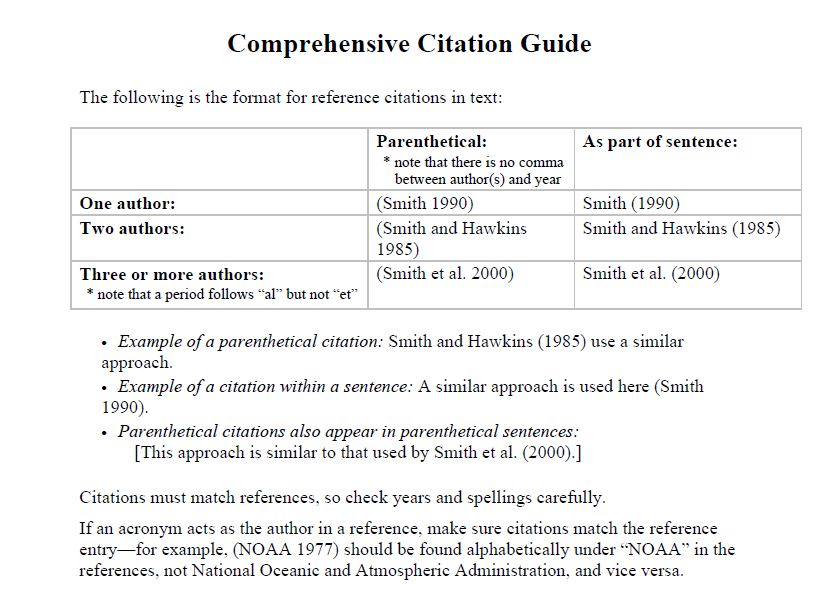 |
| Excerpt from AMS Author Reference/Citation Guide |
Scientific writing style is highly depersonalized. When you cite a reference, you are citing a paper, not the authors; you should therefore take care to cite papers in correct citation style. In a paragraph, cite the article once, then report the remainder of the contents as facts. Do not say "the author's showed that it rained " after already citing the paper; say "It rained".
- Never use first names or initials in the text;
- Never refer to authors' name without citing the year of publication;
- Never refer to "the author's", "the studies", "the paper";
- Never write in the first person; never use "I", "me", "mine";
- When writing in third person, do not use "he", "she", "they" unless the people in question are the subject of the study.
A colloquialism is an expression or word that is appropriate in conversational communication but that is awkward in formal writing. Slang refers to informal colloquialisms that aren't really acceptable in professional conversation. Jargon refers to terms in a specialized field that will likely not be understood by your target audience. None of these is appropriate in a research paper.
Sunday, December 5, 2010
Hyphens in noun clusters
Science writing employs hyphens more often than regular writing. In scientific writing, writers often refer to specific ideas or objects that would be too complex or cumbersome to describe completely every time you mention them.
Noun clusters are groups of nouns that act as one noun in your sentence. A hyphen is used to indicate that a noun is acting as an adjective to modify the subsequent noun:
Noun clusters are groups of nouns that act as one noun in your sentence. A hyphen is used to indicate that a noun is acting as an adjective to modify the subsequent noun:
- Cold-air damming led to freezing rain.
- Surface stations measured sea-level pressure.
- Upper-level temperatures indicated a strong subsidence inversion.
Note that air and level are both nouns that are used to modify the meaning of words like damming, pressure, and temperatures.
The hyphen is not used when the two words stand on their own:
- Cold air leads to lakes freezing in the winter time.
- Pressure was reduced to sea level.
- No front was observed at upper levels.
If you look carefully at any AMS article, you will notice more examples of this convention. When in doubt, check AMS publications to see how the convention is used.
As always, be careful when using hyphens as mistakes can change the entire meaning of a sentence.
As always, be careful when using hyphens as mistakes can change the entire meaning of a sentence.
Wednesday, December 1, 2010
Paragraph Structure
Each paragraph should begin with a topic sentence that acts as a thesis statement and summarizes your paragraph. If you are doing a literature review and summarizing other people's work, include the source that contains the information outlined in the paragraph. Use the active voice if possible.
Monday, November 29, 2010
Literature review and introduction
A literature review in an introduction provides an overview of past and current work in your research topic. It is usually summarized in the introduction of a thesis, and sometimes appears as a separate section. It outlines the main research questions faced in a given domain of research, and provides motivations and justifications for pursuing your research into the topic. As many students on an undergraduate level will not pursue a career in research, it's particularly important for an undergraduate thesis to understand the societal relevance of a topic and to anticipate applications of the research to "real-life" situations. Therefore, the literature review is often accompanied by a description of the societal relevance of the research.
Literature reviews can be found in the introduction practically in any refereed journal article. Almost every sentence in the introduction of most papers contains large numbers of citations, as the introduction summarizes the most important facts, theories and science on which your paper rests on. You can (almost) never have to many references in an introductory literature review.
Literature reviews can be found in the introduction practically in any refereed journal article. Almost every sentence in the introduction of most papers contains large numbers of citations, as the introduction summarizes the most important facts, theories and science on which your paper rests on. You can (almost) never have to many references in an introductory literature review.
Review papers
Review papers summarize the body of research on a topic from the earliest studies right up to ongoing research. They are periodically updated as research progresses on a given topic. A review paper is a good place to begin any study, as they put historical and current research in context, and point out when information in old papers become obsolete. They are easy to find because they are usually referenced in the introduction of most papers on the topic.
Review papers are written by leaders in this field of research, and in turn refereed by leaders in their respective fields. These papers receive more scrutiny in the review process than other papers. Controversies on a given topic are generally described neutrally. Often, the information found on websites can also be found in review papers. It's therefore preferable to check to see if information found on websites (which generally provide unrefereed writings) can be found in review papers. If so, it is better to use refereed papers from an established journal in your papers as reference.
Example
The following is an example of a paper with a literature review in the introduction of the paper:
Mitigating New York City's Heat Island: Integrating Stakeholder Perspectives and Scientific Evaluation
"Urbanization is often associated with elevated surface air temperature, a condition referred to as the urban heat island. Aspects of the urban environment that contribute to the urban heat island include i) dense, impervious surfaces that reduce evaporative latent heat cooling and increase the amount of energy that is absorbed and stored in the city; ii) low-albedo surfaces, such
as dark rooftops and asphalt roadways; iii) reduced skyview from within urban canyons, which impedes radiative longwave cooling to space, a process that is especially important at night (Oke 1981); and iv) anthropogenic heat sources associated with transportation and building heating and cooling systems (Taha 1997; Hsieh et al. 2007). Heat island intensity tends to be greatest at night, particularly when conditions are clear and calm. Local hot spots may shift with diurnal and seasonal cycles, under particular meteorological conditions, or with land use change (Unwin 1980). Landsberg (1981) and Oke (1987) describe urban climate and heat island processes. More recent reviews can be found in Arnfield (2003) and Grimmond (2007)."
This leads to a recent paper review paper by Grimmond (2007)
Grimmond, C. S. B., 2007: Urbanization and global environmental change: Local effects of urban warming. Geogr. J., 173, 83–88.
Review papers are written by leaders in this field of research, and in turn refereed by leaders in their respective fields. These papers receive more scrutiny in the review process than other papers. Controversies on a given topic are generally described neutrally. Often, the information found on websites can also be found in review papers. It's therefore preferable to check to see if information found on websites (which generally provide unrefereed writings) can be found in review papers. If so, it is better to use refereed papers from an established journal in your papers as reference.
Example
The following is an example of a paper with a literature review in the introduction of the paper:
Mitigating New York City's Heat Island: Integrating Stakeholder Perspectives and Scientific Evaluation
"Urbanization is often associated with elevated surface air temperature, a condition referred to as the urban heat island. Aspects of the urban environment that contribute to the urban heat island include i) dense, impervious surfaces that reduce evaporative latent heat cooling and increase the amount of energy that is absorbed and stored in the city; ii) low-albedo surfaces, such
as dark rooftops and asphalt roadways; iii) reduced skyview from within urban canyons, which impedes radiative longwave cooling to space, a process that is especially important at night (Oke 1981); and iv) anthropogenic heat sources associated with transportation and building heating and cooling systems (Taha 1997; Hsieh et al. 2007). Heat island intensity tends to be greatest at night, particularly when conditions are clear and calm. Local hot spots may shift with diurnal and seasonal cycles, under particular meteorological conditions, or with land use change (Unwin 1980). Landsberg (1981) and Oke (1987) describe urban climate and heat island processes. More recent reviews can be found in Arnfield (2003) and Grimmond (2007)."
This leads to a recent paper review paper by Grimmond (2007)
Grimmond, C. S. B., 2007: Urbanization and global environmental change: Local effects of urban warming. Geogr. J., 173, 83–88.
Sunday, November 28, 2010
Get to the point II: Figures
Figures
When referring to figures in text,
For the example used in the previous post, the first two sentences could be accompanied by an introduction to a figure:
You could then proceed with a detailed analysis of the figure in question.
Include all information seen in figure
Include the following information in figure where possible
The example below shows a good caption. Note how the units are clearly indicated on the graph, so there is no need to mention in the caption. Times and dates of data are clear. A legend describes the different parameters plotted, so this is not necessary to put in the captions. If these elements were missing, they would need to be in the captions. Note that analysis is done in the text.

When referring to figures in text,
- Introduce the figure and the main point it is intended to convey early in the paragraph before you begin interpreting results.
- Refer to figures in order of appearance.
- In the middle of the sentence, name of the figure is capitalized and abbreviated (e.g. Fig. 1).
- At the beginning of a sentence, name of figure is capitalized and unabbreviated (Figure 1).
- Dates/time should be in format: 8 AM EDT 8 September 2012 or 12 UTC 8 September 2012
For the example used in the previous post, the first two sentences could be accompanied by an introduction to a figure:
- "Figure 1 shows the frequency of hurricane force winds along the Florida coastline."
- "The frequency of hurricane force winds along the Florida coastline is shown in Fig. 1."
You could then proceed with a detailed analysis of the figure in question.
Include all information seen in figure
Include the following information in figure where possible
- Figure title
- Contour labels
- Axis labels
- Parameters
- Dates and times
- Parameters plotted
- Contour intervals with units
- Source
The example below shows a good caption. Note how the units are clearly indicated on the graph, so there is no need to mention in the caption. Times and dates of data are clear. A legend describes the different parameters plotted, so this is not necessary to put in the captions. If these elements were missing, they would need to be in the captions. Note that analysis is done in the text.

Get to the point I: Paragraph structure
Paragraph Structure
Each paragraph should begin with a topic sentence that acts as a thesis statement and summarizes your paragraph. If you are doing a literature review and summarizing other people's work, include the source that contains the information outlined in the paragraph. Use the active voice if possible.
Prefaces and Segues
A common mistake many students make in scientific and technical writing is to preface paragraphs containing important information about the atmosphere with unnecessary segues and prefaces:
"Studies of hurricanes have shown that they are a dangerous phenomenon. They represent an important aspect of the tropical environment."
This may be okay in oral presentations, conversation, literary work, personal diaries, and rants on blogs, but only wastes valuable space in technical reports and science papers. You want to make it as easy as possible for your reader to get the information they need to know.
References and example
It is good style to begin any paragraph with the main point. It is equally good style to begin the first sentence of the paragraph with the reference that backs up this point:
"Smith et al. (2010) showed that hurricanes can cause significant amounts of damage when they strike populated areas. "
This forces you to use the active voice, makes it clear that you are presenting information from an authoritative source, and makes subsequent referencing unnecessary.
If you need to provide secondary references that add to the credibility of the information, this can be done with brackets:
"They used 6-hourly sea-level pressure fields from the NCEP/NCAR reanalysis (Kistler et al. 2001) for the years 1951-2000 to examine hurricane tracks in the North Atlantic Ocean. "
This gives the reader information they can use to assess the quality of the study and to reproduce the results if necessary.
If the order of the above sentences were reversed, the paragraph is less clear because the secondary (albeit important) information appears first, and the main point of the paragraph second. Your reader will mumble under his breath "Get to the point".
Each paragraph should begin with a topic sentence that acts as a thesis statement and summarizes your paragraph. If you are doing a literature review and summarizing other people's work, include the source that contains the information outlined in the paragraph. Use the active voice if possible.
Prefaces and Segues
A common mistake many students make in scientific and technical writing is to preface paragraphs containing important information about the atmosphere with unnecessary segues and prefaces:
"Studies of hurricanes have shown that they are a dangerous phenomenon. They represent an important aspect of the tropical environment."
This may be okay in oral presentations, conversation, literary work, personal diaries, and rants on blogs, but only wastes valuable space in technical reports and science papers. You want to make it as easy as possible for your reader to get the information they need to know.
References and example
It is good style to begin any paragraph with the main point. It is equally good style to begin the first sentence of the paragraph with the reference that backs up this point:
"Smith et al. (2010) showed that hurricanes can cause significant amounts of damage when they strike populated areas. "
This forces you to use the active voice, makes it clear that you are presenting information from an authoritative source, and makes subsequent referencing unnecessary.
If you need to provide secondary references that add to the credibility of the information, this can be done with brackets:
"They used 6-hourly sea-level pressure fields from the NCEP/NCAR reanalysis (Kistler et al. 2001) for the years 1951-2000 to examine hurricane tracks in the North Atlantic Ocean. "
This gives the reader information they can use to assess the quality of the study and to reproduce the results if necessary.
If the order of the above sentences were reversed, the paragraph is less clear because the secondary (albeit important) information appears first, and the main point of the paragraph second. Your reader will mumble under his breath "Get to the point".
Subscribe to:
Posts (Atom)
